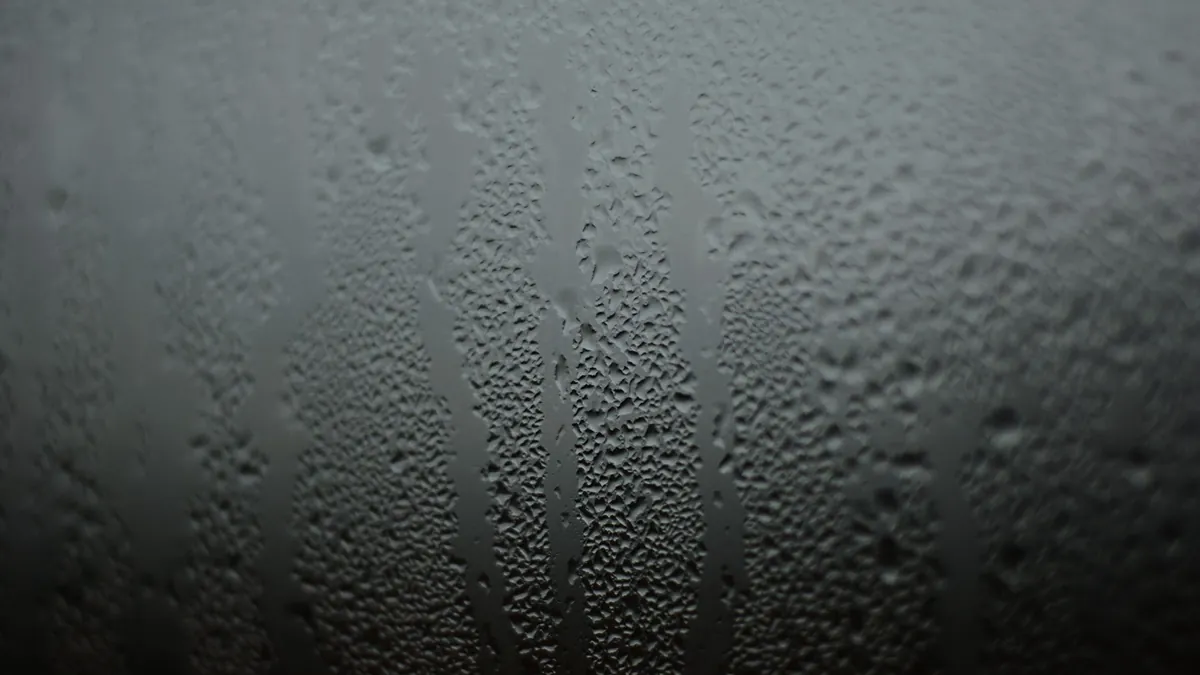
A wall that turns wet the first week the heating comes on is not dirty, and it is not usually leaking. It is the last step in a short chain: warm air carries water vapour, that air reaches a surface colder than it can tolerate, and the surplus water drops out onto the surface. Nothing came through the wall. The water was in the air of the room all along.
That is good news, because it means you can fix it from inside the room, and you can often do it without tools.
Read the cold spot before you clean anything
Warm air holds more water vapour than cold air. As air cools, it eventually reaches the temperature at which it can hold no more, and any surface at or below that temperature collects water. In a normal room the middle of a wall is warm enough. The damp shows up where a surface is unusually cold: a corner with less insulation, the strip behind a wardrobe or a headboard, the reveal around a window, or a wall with a cold water pipe running through it.
Where the damp appears tells you which half of the chain to fix:
| What you see | What it usually means | Start here |
|---|---|---|
| Windows fogged, wall below them damp | The room’s air is carrying too much moisture | Cut moisture at the source |
| Damp strip behind a wardrobe, sofa or bed | No air movement across a cold wall | Pull furniture away from the wall |
| Damp top corners and ceiling edges | Weak insulation or a gap in air sealing | Check insulation and draughts |
| One patch that never dries, tide marks, damp after rain | Water is entering from outside | Drainage and leak repair, not a dehumidifier |
Measure the humidity instead of guessing
Guessing leads to the wrong fix, and a humidity meter costs less than a tube of sealant. The EPA suggests an inexpensive meter (in the $10 to $50 range) and keeping indoor humidity below 60 percent, ideally between 30 and 50 percent. Montana State University Extension narrows that for the heating season, where it puts the target at around 30 to 45 percent.
Take two readings a day, morning and evening, standing in the middle of the affected room. Then read the result together with the wall:
- If humidity sits above 50 percent and surfaces are damp, the air is the problem.
- If humidity sits at 30 to 40 percent and one wall is still wet, that surface is too cold. Move to insulation and airflow.
Glass is a free indicator you already have. On single-glazed windows, some condensation at normal indoor humidity is simply what cold glass does. When a double-glazed pane in the same room is sweating, the room is wetter than its own windows can tolerate, and the wall comes next.
Subtract the moisture you add every day
Most of the water on your walls is water you produced. Montana State University Extension measured the daily load for a family of four and put it at about 55.9 pounds, or 6.7 gallons of water per day:
| Source | Water added per day |
|---|---|
| Four people breathing and perspiring | 16.8 lb |
| Drying clothes indoors (dryer vented to the inside) | 26.4 lb |
| Washing clothes | 4.3 lb |
| Mopping floors | 2.4 lb |
| Shower or bath | 2.0 lb |
| Cooking on a range with no exhaust fan | 2.0 lb |
| Hand dishwashing | 1.0 lb |
| Houseplants | 1.0 lb |
The list also doubles as a to-do list. Vent the bathroom fan during the shower and leave it running for about 20 minutes afterwards, because the moisture keeps leaving the walls and towels after the water stops. Put a lid on boiling pans, run the kitchen exhaust, keep the dryer vented outside rather than into the room, and cover a dirt crawl space with 6 mil plastic. The EPA also suggests switching off humidifiers when you start seeing water on windows, since adding moisture to a room that is already condensing makes the problem worse on purpose.
Warm the cold surface
If the air is already in the right range, the second half of the chain is the surface itself.
Move air across it
Still air is what lets a cold wall stay cold. Leave a gap behind furniture rather than pushing a wardrobe or headboard flat against an exterior wall, keep supply and return vents clear, open closet doors on exterior walls, and run a ceiling fan on low to keep air moving in winter. Even in a tight room, a hand’s width of clearance changes how much heat reaches that wall, a habit that also makes a small living room feel less crowded.
Give windows a second layer
A storm window paired with an existing single pane raises the glass surface temperature and cuts window condensation noticeably. The air gap between the two layers is what does the work, and the EPA notes that an inside-mounted storm window performs better than an outside one. Adding a second layer to a double-glazed window is not usually cost-effective, but it does let you run a slightly higher indoor humidity without water appearing. Curtains help at night by holding heat against the glass, but keep them open during the day so warmth can reach the window surface.
Insulate what stays cold
If a corner is still wet after airflow and humidity fixes, the wall is under-insulated or has an air leak feeding it. As a reference point, Montana State University Extension lists typical cold-climate targets of R 19 for above-ground walls and R 38 for ceilings. Replacing windows alone rarely solves wall condensation, because the wall next to the window is still the coldest thing in the room.
Habits that quietly make it worse
- Closing the door to a spare room and turning its heat down. Cold rooms condense first, and they need air movement more than they need to be shut away.
- Running the bathroom fan only while you are in the shower.
- Drying laundry on a radiator in a closed room, which is the single biggest item on the list above.
- Painting over the damp patch or treating anti-mould paint as a repair.
- Blocking a register with a sofa, which stops the room from drying itself out.
When it is water, not condensation
A leak looks different from a cold wall. One patch with a clear edge, a brown tide mark, a musty smell in the same spot, or damp that arrives after heavy rain all point to water getting in from outside. Check gutters and downspouts first, then the ground, which should slope away from the foundation. Bubbling or paint peeling off in one area is another sign that the surface is being wetted repeatedly rather than just being cold.
If the damp has been there long enough to turn dark, clean the surface properly and dry it completely first, then fix the moisture: mold on walls comes back within weeks when the water source is still there.
A one-week plan
- Day 1. Put a humidity meter in the affected room and note the reading morning and evening.
- Days 1 and 2. Fix the sources: bathroom fan, kitchen exhaust, dryer venting, no indoor laundry drying.
- Day 3. Pull furniture off the cold wall, clear the vents, open the closet doors.
- Days 4 and 5. Deal with the window layer and check for draughts and missing insulation.
- Day 7. Read the meter again. If humidity is under 45 percent and the wall is dry, keep the habits. If the wall is still wet, move to a dehumidifier in that room, and if one patch stays wet while the rest dries, treat it as a leak.