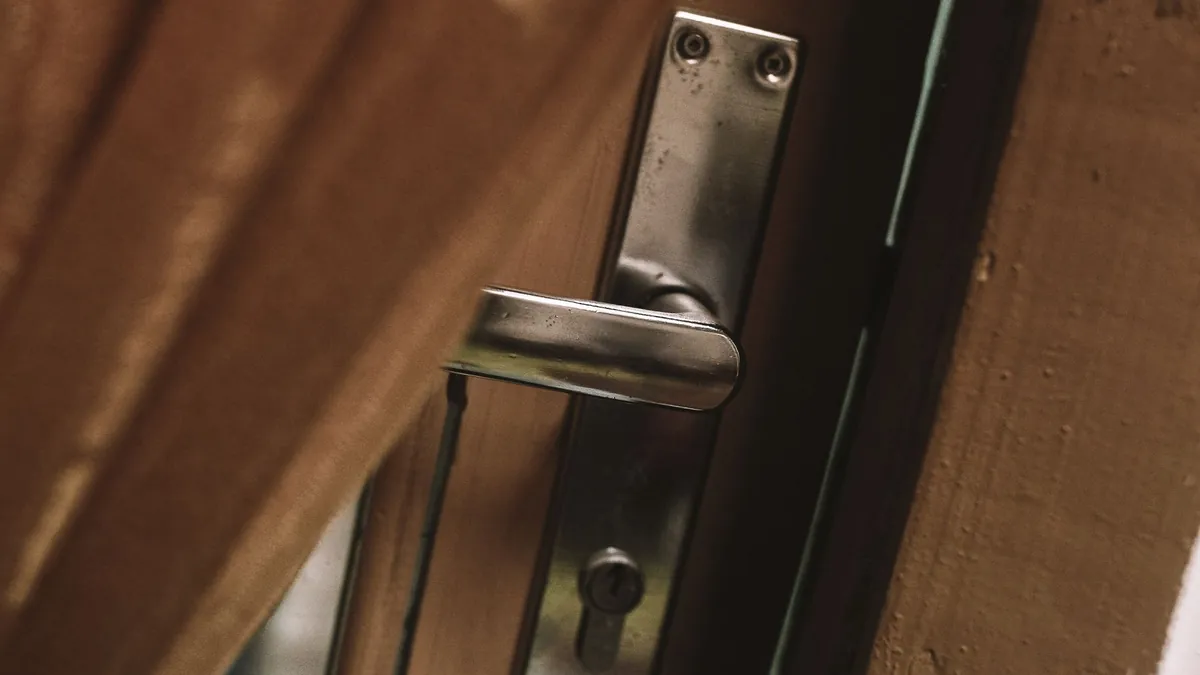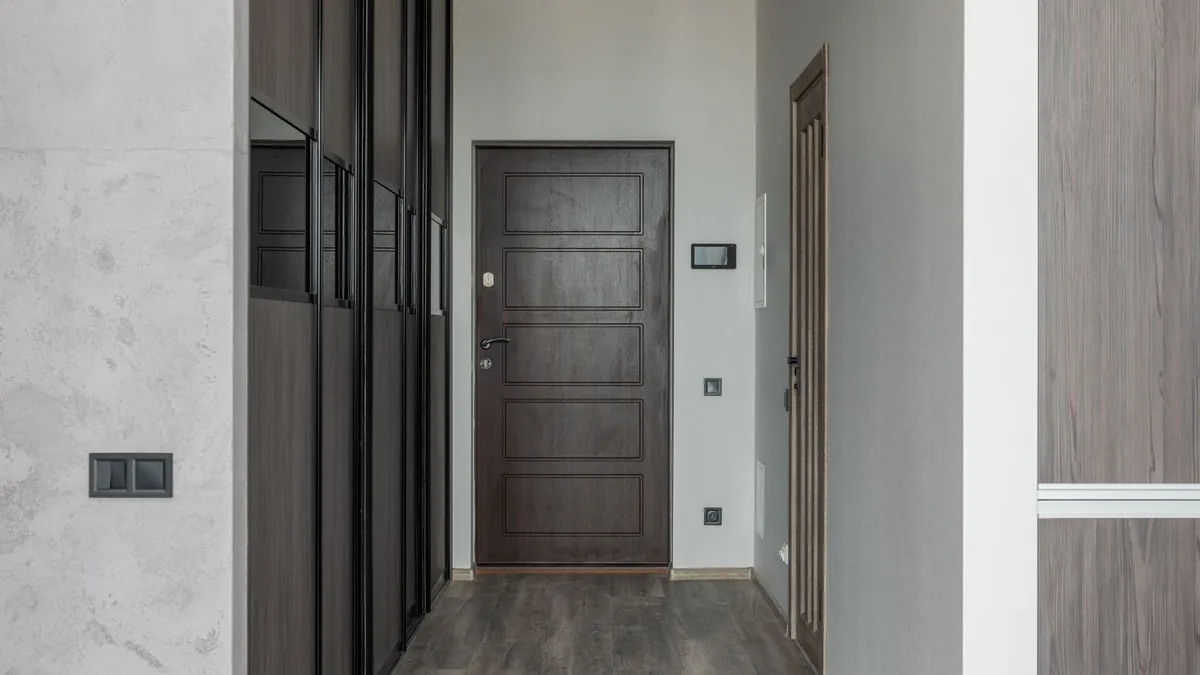
There is a particular kind of cold that you notice at ankle height, in one spot, no matter how high the thermostat is set. It runs along the floor near a door, and it is there every evening once the outside temperature drops. That ribbon of moving air is not the same as a cold surface. It is outside air being pushed into the house through one gap.
Most of the time the gap is at the bottom of the door, and most of the time it can be closed in an afternoon with basic tools and a single piece of hardware. The part that people get wrong is buying the seal before they have looked at the gap, which is how a brush sweep ends up under a door with a hole the size of a pencil.
How do you find the leak before buying a seal?
Air leaks are quiet and slow, so they are easy to misread. Test one edge at a time instead of standing in the draft and guessing.
- Lay a single ply of tissue flat on the floor in front of the door. If it lifts or trembles with the door shut, air is coming under the door.
- Repeat along the hinge side, the latch side and the top of the frame. A hand is a poor sensor at this air speed, so watch the tissue rather than your fingers.
- On a dark evening, set a small flashlight on the floor against the door. Light escaping under the door shows the shape of the gap, and a gap that is tight at one end and open at the other points to a door that is not hanging square.
When you find the gap, measure it rather than estimating. A steel rule or a set of drill bits used as gauges will tell you far more than a finger pushed into the opening.
Why does the bottom gap leak more than the rest?
A house does not leak because outside air is being blown in evenly. It leaks because warm indoor air is buoyant and wants to leave, and it leaves highest up first, through ceiling openings, recessed lights and the top of stairwells. As it escapes, the house has to replace that air, and the replacement comes in from outside wherever it can find an opening, which is mostly low in the building. This is why the coldest, most persistent drafts in a house are usually the low ones, at doors and at the base of walls, even on a still day.
That is also why the scale of small leaks is easy to underestimate. Air sealing around the envelope, plus the right amount of insulation, is one of the few home improvements with a quick payback: the EPA estimates that homeowners can save an average of 15 percent on heating and cooling costs, or around 11 percent of total energy costs, by sealing air leaks and adding insulation in attics, floors over crawl spaces and basements. A single door gap will not deliver that on its own, but it is the cheapest piece of the same job.
If one room stays noticeably colder than the others even with its door shut, the door gap is only part of the story, and the guide to a room that is always colder than the rest covers the other causes worth checking.
Which under door seal fits which gap size?
Seals are sold by type and rarely by the gap they close, so work from the measurement you just took.
| Gap at the door bottom | What fits | What to watch |
|---|---|---|
| Under 1/8 inch, even along the whole width | Adhesive foam or vinyl bulb weatherstripping on the door bottom | Cheap and quick, but foam flattens over a season or two on a door that is used daily |
| Around 1/8 to 3/8 inch, even | Brush sweep in an aluminum carrier, or a rubber sweep with a small lip | The most common case, and the easiest to fit |
| Around 3/8 to 3/4 inch | Rubber or neoprene sweep with a deep fin, or a slide on under door seal fitted to the face of the door | Bristles alone will not hold this gap |
| Over 3/4 inch, or the gap differs a lot side to side | An adjustable threshold, a threshold riser, or hinge work to lift the door | A seal can cover the gap but the door is probably not hanging square |
Along the hinge side, the latch side and the top of the frame, the right product is a different one: a self adhesive or kerf mounted weatherstrip that compresses slightly when the door closes. Replacing it is the fix when a draft appears at the sides even though the bottom is sealed.
How do you fit a door sweep so it holds?
A sweep is the part most people start with, and it is the part most likely to be fitted badly. The order below avoids the usual problems.
- Close the door and check how it sits. Look for a gap that varies along the width, which is a sign the door has dropped on its hinges.
- Cut the sweep to the width of the door face, not the frame. Sweeps are supplied long enough for the widest doors, and a piece that overlaps the frame will catch on the jamb and tear off within weeks.
- Fit the sweep to the face of the door with its fin or bristles just touching the floor. Most sweeps come with screws that go into the door face, and two or three short screws hold better than adhesive tape in cold weather.
- Test the swing before you tighten everything. Open and close the door through its full arc. A sweep that is set too low rubs the floor, marks a hard finish and wears its own edge away.
- Check the corners. Air leaks hardest at the bottom corners of the door, so if the sweep stops short on either side, the draft will simply move sideways.
If the door has dropped, deal with the hinges first. Tightening or replacing the screws in the top hinge, and in some cases shimming the hinge on the frame side, lifts the door so the gap becomes even, and an even gap is far easier to seal.
Sealing the sides and the top of the frame
The bottom gap is the one that gets felt, but the sides and the top usually leak at the same time. Run the tissue test again after the sweep is fitted. If air is still moving around the frame, look at the weatherstrip in the doorstop, the strip of trim the door closes against. Old foam strips there go flat and crumbly, and the seal becomes a decoration. Replacement is a straightforward job: pull the old strip out, clean the surface back to bare timber, cut the new one slightly long and push it into place so it compresses when the door shuts rather than bunching at the corners.
Where there is a bigger gap around the frame, or a visible opening between the frame and the rough wall behind the trim, sealing behind the window and door trim follows the same principle: fill the cavity without stopping the door from closing cleanly. Caulk is for joints that do not move, and low expansion foam is for the gap between the frame and the wall, not for the gap the door swings through.
Windows are the other opening worth a look while the tools are out. Coverings change how the glass feels to sit next to, but they do not close a leak, which is worth knowing before buying anything heavier than a seal, as curtains and blinds compared sets out. Sealing also keeps interior surfaces warmer, which is half of the answer to condensation that keeps forming on walls.
When the door itself is the problem
Some drafts will not yield to any seal, because the door has stopped fitting its opening. The signs are consistent: the gap at the bottom is much wider on the latch side than the hinge side, the door rubs the frame as it closes, or daylight is visible around three edges at once. That is a geometry problem, not a sealing problem, and the usual causes are hinges that have pulled loose, a frame that has moved with the house, or a door that has warped across its width as it dried out.
Hinges can often be reset with longer or wider screws, or by chiselling the hinge leaf slightly deeper into the jamb. A frame that has gone out of square is a carpentry job, and a door that has warped may never seal properly whatever is fitted to it.
Do not seal the house shut
One caution applies to all of this. Making a house airtight without thinking about how it breathes can change how other appliances behave, and ENERGY STAR notes that sealing a home or its ductwork in some situations can cause combustion appliances such as water heaters to backdraft, which creates unsafe conditions indoors. If you have a gas or oil appliance that draws its air from inside the house, keep a supply of fresh air and have a qualified technician check it before you make the house much tighter.
A door gap is a small, safe place to start.