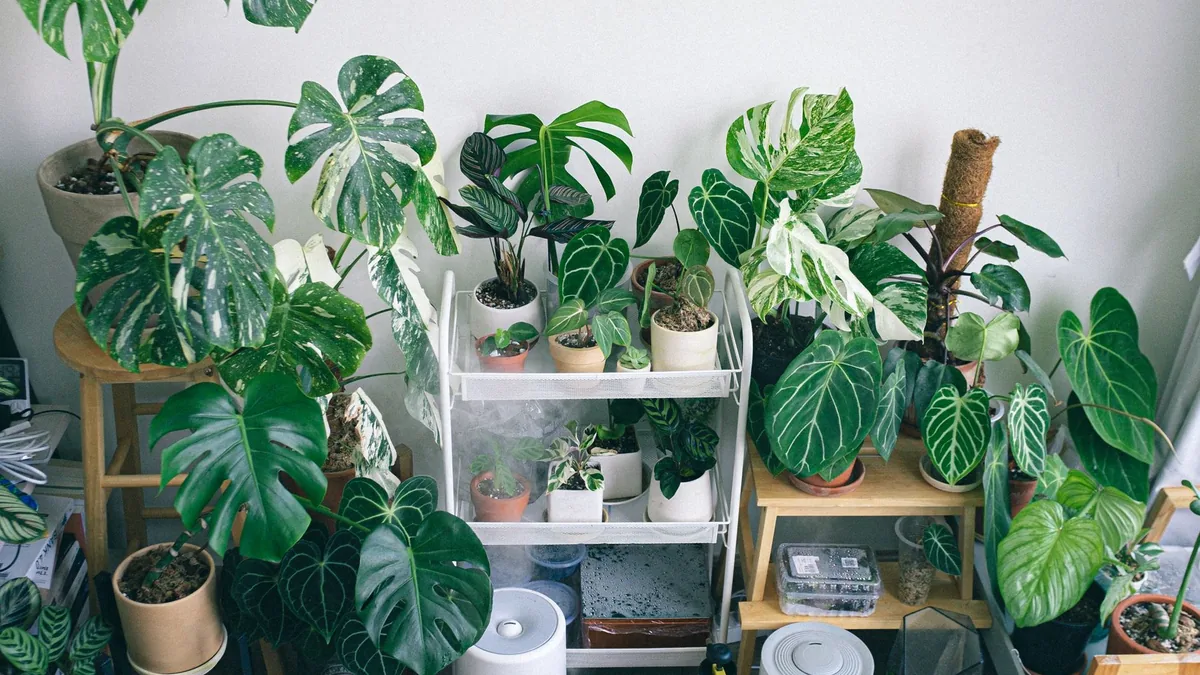
A heated home commonly drops below 30 percent relative humidity in winter, while most houseplants grow best between 40 and 60 percent. The dependable fix is a humidifier placed close to the plants and checked with a hygrometer. Grouping pots helps a little, pebble trays help far less than most guides suggest, and misting fades within minutes. Raising the number is a race between the moisture you add and the dry air that heating, ventilation, and cold outdoor air keep pulling in.
Why Does a Heated Home Dry Out in Winter?
Cold outdoor air carries very little moisture, and warming it indoors lowers the relative humidity further. Penn State Extension notes that indoor relative humidity often falls below 30 percent once the heating season starts, against the 30 to 60 percent band the American Society of Heating, Refrigerating, and Air Conditioning Engineers recommends for indoor air. That is dry for people and drier still for plants that evolved under a tropical canopy. The first sign is usually cosmetic: leaf edges turn dry, brown, and papery while the rest of the leaf stays green. A spot near a heat vent, a radiator, or a door that opens to the cold makes it worse, because fast warm air pulls water out of the leaves faster than the roots can replace it.
What Humidity Level Do Houseplants Need?
There is no single number, because houseplants come from different climates. University of New Hampshire Extension places most houseplants in the 40 to 60 percent range, with true tropical species such as ferns and calatheas happiest at 70 to 80 percent. Desert plants are the exception and manage fine in ordinary room air. Washington State University Extension gives the same 70 to 80 percent target for plants that struggle indoors and notes that the average home sits below 60 percent all year, dropping further once the heat runs. In practice, holding a room between 40 and 50 percent keeps most collections healthy without fogging the windows.
Which Methods Actually Move the Number?
Only two approaches change the humidity of the room itself: adding moisture with a humidifier, and slowing the rate at which dry air replaces the air around the plants. Everything else works on a much smaller scale, which is fine for one fern on a desk and useless for a shelf of plants in a large room.
| Method | What It Does | Best For |
|---|---|---|
| Humidifier | Adds moisture to the whole room | Large collections in one room |
| Grouping pots | Traps a pocket of transpired moisture | Small groups in still air |
| Glass enclosure | Holds near constant humidity | Terrariums and single plants |
| Pebble tray | Moistens the air just above the stones | One plant on a desk |
| Misting | Wets the leaves for a few minutes | No lasting benefit |
A humidifier earns its place because it keeps producing while the furnace keeps drying. Run it near the plants rather than across the room, and expect several hours of daily running to hold a normal bedroom in the forties.
Do Pebble Trays and Misting Really Work?
Both are popular, and both do far less than their reputation suggests. Penn State Extension explains why a tray of wet pebbles barely shifts the room reading: the evaporated air diffuses into the entire room instead of rising to the plant, so the change is close to unmeasurable. Nebraska Extension still lists a pebble tray as an option, but describes it as raising humidity around the foliage, which holds only in still air and with several trays in one spot. Misting is shorter lived still. Illinois Extension states plainly that misting leaves the humidity higher for only a short time, needs constant repetition, and can encourage disease on plants that dislike wet foliage. If you keep a tray anyway, fill it with stones and stand the pot above the water so the soil never wicks it up.
How Do You Measure Humidity and Hold the Target?
A cheap digital hygrometer turns this from guesswork into a number you can act on. Place it at the height of the leaves rather than on the floor, keep it away from heat vents, radiators, and window glass, and read it in the morning and again in the evening, since the value swings as the heat cycles. Run the humidifier until the room holds between 40 and 50 percent, then let it switch on and off. There is a limit worth respecting: pushing indoor humidity past about 60 percent in winter puts moisture onto cold surfaces, the same water that fogs windows and feeds condensation on exterior walls. A room sitting at 45 percent with the humidifier cycling is doing better than a steamy corner at 80 percent.
What to Fix First When Only One Plant Is Struggling
Not every plant needs the whole room changed. If a single fern or calathea crisps at the edges while the rest of the collection looks fine, move it into a smaller room with low airflow, group it with two or three other pots, or stand it under a clear cover for a week and watch the new leaves. A plant that browns every winter despite good light and steady watering is telling you the air is the problem, not the soil. Before blaming humidity, rule out the other causes of damaged leaf edges, which include tap water, fertilizer salts, and uneven watering, in the guide to reasons for brown leaf tips. Thin-leaved plants such as the calatheas and prayer plants covered here are worth prioritizing, because they show damage first and recover slowly.


