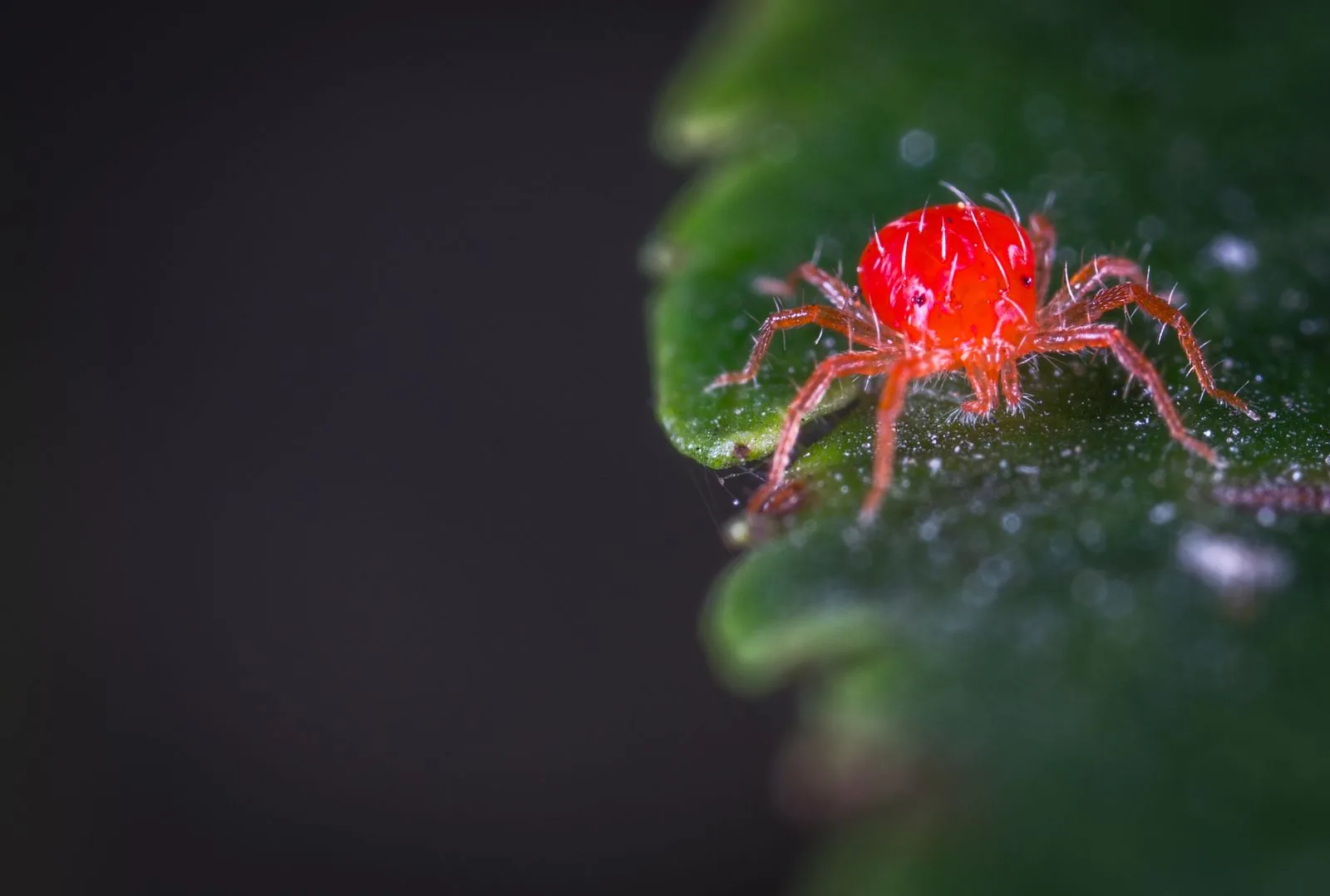
Spider mites are tiny sap-sucking pests, not insects, and they can strip a houseplant from healthy to bare in a few weeks. Getting rid of them is a routine, not a single spray. Move the plant away from your others, rinse every leaf on both sides with a strong stream of water, then treat with insecticidal soap or horticultural oil and repeat every five to seven days for three weeks. The repeat step matters more than the product, because eggs survive most sprays and hatch within about a week, so one application only clears the mites you can see. Raise the humidity, check a white sheet of paper under the leaves for moving specks, and keep going. Most plants recover fully if you catch the infestation before the webbing gets dense, and even badly hit plants often push new growth once the mites are gone.
What Do Spider Mites Look Like?
Spider mites are arachnids, so they have eight legs and a single unsegmented body. They belong with spiders and ticks rather than insects. Adults are barely visible, only around 1/50 of an inch long, and usually pale yellow-green with two dark patches on the back, though they shift to orange-red in autumn and winter. The Missouri Botanical Garden notes that they live mostly on the undersides of leaves, where their feeding shows up first.
The damage is easier to spot than the mite itself. Feeding empties plant cells and leaves a fine, pale stippling across the upper surface, so the leaf looks dusty, dull, or washed out. Heavier feeding turns leaves yellow, then tan or brown, and eventually they drop. In a bad infestation you will also see fine silk webbing in the joint where a leaf meets the stem.
A simple test confirms it. Hold a sheet of white paper under a leaf and tap the leaf sharply. If tiny specks land on the paper and start crawling, you have spider mites.
Why Do Spider Mites Keep Coming Back?
Because one spray never reaches every stage of their life cycle. A single female lays around 70 eggs and lives about 30 days, the eggs hatch in five to seven days, and a mite can go from egg to adult in under two weeks, according to the Missouri Botanical Garden. Outdoors that adds up to as many as ten generations a year, and on a warm indoor shelf the cycle barely slows down.
The Royal Horticultural Society explains the temperature link. The whole life cycle takes about 55 days at 50 F but only 12 days at 70 F, which is why mites explode in warm, dry rooms and slow down in a cool, damp one.
Here is the practical consequence. A spray kills the mites it touches, but the eggs tucked under the leaf, along the veins, and in the leaf joints survive and hatch a few days later. If you spray once and stop, you have cleared only the first wave. Repeated treatment, timed to the hatching cycle, is what breaks the loop.
How Do You Get Rid of Spider Mites for Good?
Work through these steps in order, then repeat the treatment cycle for a full three weeks before you judge the result.
- Isolate the plant. Move it away from your other houseplants, ideally to a different room, so wandering mites cannot spread while you treat it.
- Rinse the foliage. Take the plant to a shower or sink and spray the leaves with a strong stream of water, aiming at the undersides where mites cluster. This alone knocks off a large share of them.
- Treat with soap or oil. Coat both leaf surfaces, the stems, and the soil surface with insecticidal soap or horticultural oil. Iowa State University Extension treats washing and these low-toxicity sprays as the first line of control on indoor plants.
- Repeat every five to seven days for three weeks. Each round catches the mites that hatched since the last one.
- Raise humidity and ease off fertilizer. Mites prefer dry air and soft, nitrogen-rich new growth.
- Keep testing. Tap a leaf over white paper every few days, and stop only after two clean checks in a row.
Which Treatment Should You Choose?
Different treatments suit different situations. The table below compares the common options for indoor plants.
| Method | Best For | Repeat |
|---|---|---|
| Water Shower | Light Infestations | Every Two To Three Days |
| Insecticidal Soap | Visible Mites | Weekly For Three Weeks |
| Horticultural Oil | Eggs, Larvae, Adults | Every Seven To Ten Days |
| Miticide Spray | Stubborn Infestations | Per Label, Often Weekly |
Start with water and soap for a light infestation, since they are cheap and low-risk. Move to horticultural oil when webbing appears, because the oil smothers eggs as well as adults. A dedicated miticide is the last step for a plant that keeps relapsing after three proper weeks. One warning is worth repeating from the University of Maryland Extension: ordinary insecticides rarely work on mites, and some, including pyrethroids, can trigger a worse outbreak by killing the predators that were keeping mites in check.
Which Houseplants Do Spider Mites Attack Most?
They are not picky. The University of Maryland Extension lists aroids such as Alocasia, Philodendron, and Anthurium, along with African violets, peperomias, begonias, orchids, palms, miniature roses, citrus, and herbs, among the indoor plants they commonly damage. Ivies and other thin-leaved plants are frequent targets too, while thick-leaved succulents tend to fare better.
The common thread is the environment, not the plant list. Warm, dry rooms with still air and stressed plants invite outbreaks, so almost any houseplant is at risk if those conditions line up.
How Do You Stop Spider Mites From Coming Back?
Mites rarely take hold in a strong, humid, well-tended plant. A few habits keep them from returning, and the routines that keep fungus gnats out of your pots help here too.
- Raise humidity. Dry air speeds their breeding. Grouping plants, a pebble tray, or a small humidifier all help, and the same steps covered in this guide to increasing humidity for houseplants make a room less inviting.
- Keep leaves clean. A regular wipe of the upper and lower surfaces removes dust and lets you spot stippling early. The method is in this guide to cleaning houseplant leaves.
- Skip the heavy feeding. Extra nitrogen pushes the soft new growth that mites prefer.
- Quarantine new plants for two weeks, and check them for webbing and stippling before they join your collection.
- Inspect weekly. The white paper tap test takes a minute and catches a problem while it is still small.
When Should You Give Up and Toss the Plant?
Sometimes the kindest move is the bin. If a plant is draped in webbing, most of its leaves have bronzed or dropped, and three weeks of treatment has not turned it around, replacing it is cheaper and safer than fighting on. A badly hit plant also acts as a reservoir that keeps re-infesting the healthy ones nearby.
Iowa State University Extension advises discarding a plant that is heavily infested. If you do, seal it in a bag and put it in the trash rather than the compost, then check the plants that sat closest to it. Clean the pot and saucer with hot, soapy water before you reuse them.


