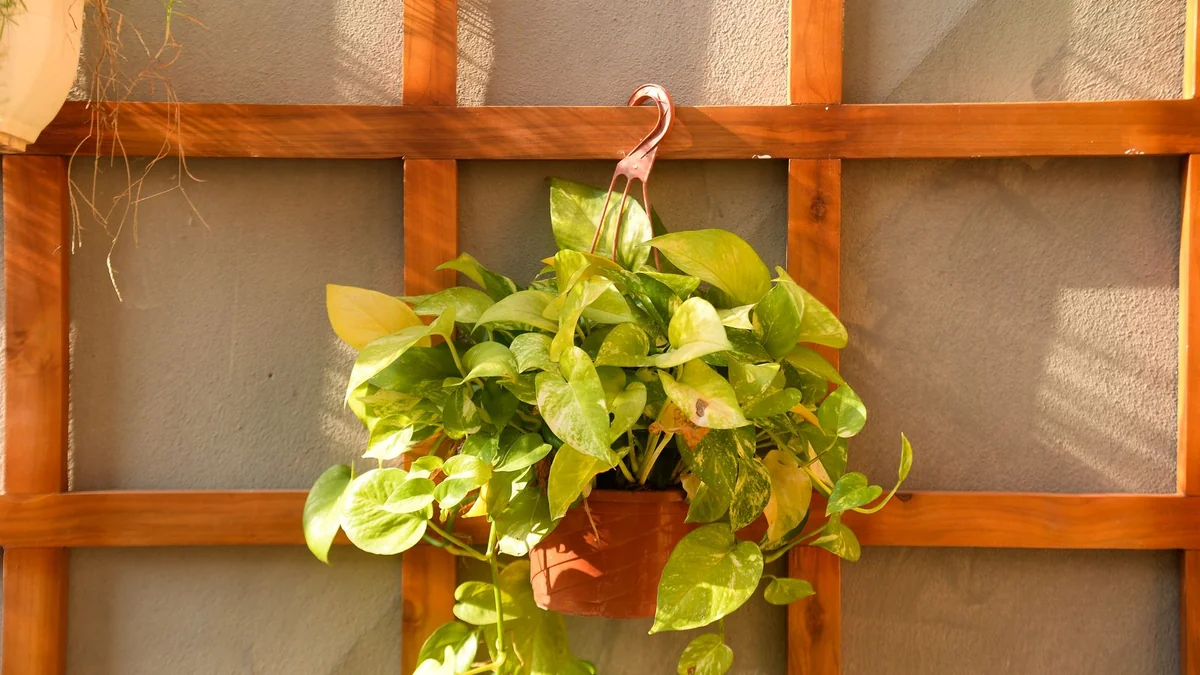
A leggy pothos is not a sick plant. It is doing exactly what its wiring tells it to do: reach for the light and keep extending the vine it already has. The result is a long stem with a leaf, a long gap, another leaf, and almost nothing at the soil line.
Legginess is one of the easiest houseplant habits to reverse, and the fix works on almost any vining plant. The key is knowing whether your plant is stretching for light or simply overdue for a haircut, because the two need different responses.
First, measure the gap between leaves
Before you touch anything, compare the spacing between leaves on the newest part of the vine with the spacing near the base, close to the soil.
On a pothos growing in decent light, the leaves stay fairly close together along the stem. When the vine is starved for light, each new leaf is placed further from the last, because the plant invests its energy in stretching the stem instead of building leaves. That widening gap is the signal, and you can see it without any tools.
- Close spacing, normal leaf size: enough light, the plant just needs a trim.
- Widening gaps, smaller and paler new leaves: light is the limiting factor.
- Bare stem in the middle, healthy growth further along: leaves dropped earlier, usually from watering problems.
Cause 1: the vine is stretching toward light
This is the most common reason a pothos looks thin, and it is easy to underestimate how fast light falls off in a room. A spot that looks bright to your eyes can be a dim corner from the plant’s point of view.
The benchmarks horticulturists use are the ones worth knowing. Illinois Extension groups houseplants as low light (about 75 foot-candles, a north window a few feet away or an east or west window 3 to 10 feet away), medium light (about 150 foot-candles, right in front of a north window or a few feet from an east or west window), and high light (about 300 foot-candles, up to 5 feet from a south window). See the full breakdown in the Illinois Extension houseplant lighting guide. University of Maryland Extension uses a similar scale and calls 25 to 100 foot-candles low light in its guide to lighting for indoor plants.
The practical takeaway: if a pothos sits more than a few feet from a window, or the window faces north, or a curtain stays closed, the plant is probably working in the low-light range. Move it closer to bright, indirect light and the next leaves will come in tighter.
Fix: shift the pot to within a few feet of an east or west window, or a couple of feet behind a sheer curtain on a south window. Turn it a quarter turn each week so the vine does not lean permanently one way, and keep it out of harsh midday sun, which scorches pothos leaves rather than feeding them.
Cause 2: the vine was never cut back
Pothos grows from the tip of the vine. The growing tip produces hormones that hold back the buds further down the stem, so the plant keeps adding length instead of branches, and you end up with one or two long runners in a pot that looks half empty.
Cutting is what breaks that signal. Maryland Extension describes pinching as removing an inch or less of new stem and leaf growth just above a node, which stimulates new lateral growth to make a well filled-out houseplant, on its page about grooming indoor plants. On a leggy pothos the same logic applies at a larger scale: every cut just above a node wakes up the buds behind it.
Cause 3: bare stems from earlier leaf loss
A bare middle section does not happen by itself. Pothos drops older leaves when it has been consistently overwatered, left to dry out too hard, or kept in a cold draft. Those nodes will not regrow leaves, so no amount of watering brings them back. The only way to cover that section is to cut the bare stem off and use the leafy part, or to pin a vine across the soil so it roots into the mix. If the lost leaves followed wet soil and yellow lower leaves, the underlying problem is watering, and our guide to curling pothos leaves covers how to read those signals.
How to fix a leggy pothos in four steps
- Move it into better light first. Fixing the light before cutting means the new growth that follows the trim will be compact. Trim a plant in a dark corner and the new shoots stretch again.
- Cut the vines back to a node. Work vine by vine. Follow each stem back toward the soil and cut just above a node, leaving two or three nodes on the piece that stays in the pot. Remove no more than about a third of the plant in one session.
- Keep the cuttings for rooting. Cut each piece into sections with two or three nodes, take the lower leaves off, and root them in water or directly into moist mix. Our step-by-step pothos propagation guide covers both methods.
- Fill the pot and wait. Put rooted cuttings back into the pot or a fresh one, water, and keep the plant in bright, indirect light. New shoots from the nodes below each cut usually appear over the following weeks while the plant is growing actively; in winter growth can stall until light levels rise.
Why cuttings in the same pot stay small
Replanting cuttings into the mother plant’s pot is the standard trick for a fuller plant, but it fails when the pot is already packed with roots. A root-bound pothos has little fresh soil left, so the cuttings compete for water and nutrients with an established root system and often sit there without growing. Either repot the mother plant into a container one size larger with fresh mix at the same time you add the cuttings, or start the cuttings in their own pot. If your pothos has stalled in other ways too, the checks in our guide to why a houseplant stops growing cover root crowding, soil condition, and feeding.
Keeping it full from now on
- Prune once or twice a year, in spring or early summer, instead of waiting until the vines are bare.
- Keep the plant close enough to a window that new leaves come in tightly, and rotate it weekly.
- Water when the top couple of centimeters of soil dry out, and empty the saucer so roots never sit in water.
- Pin a long vine across the soil surface in a few spots. Where a node touches damp mix it can root and send up a new shoot.
- Do not try to fix legginess with fertilizer. In low light, extra nutrients push soft, weak growth rather than dense growth, because the plant cannot use them without enough light.
A trimmed pothos looks drastic for a week or two. Give it steady light, keep the soil evenly moist, and the plant that looked stringy will push several new shoots from the cut points.


