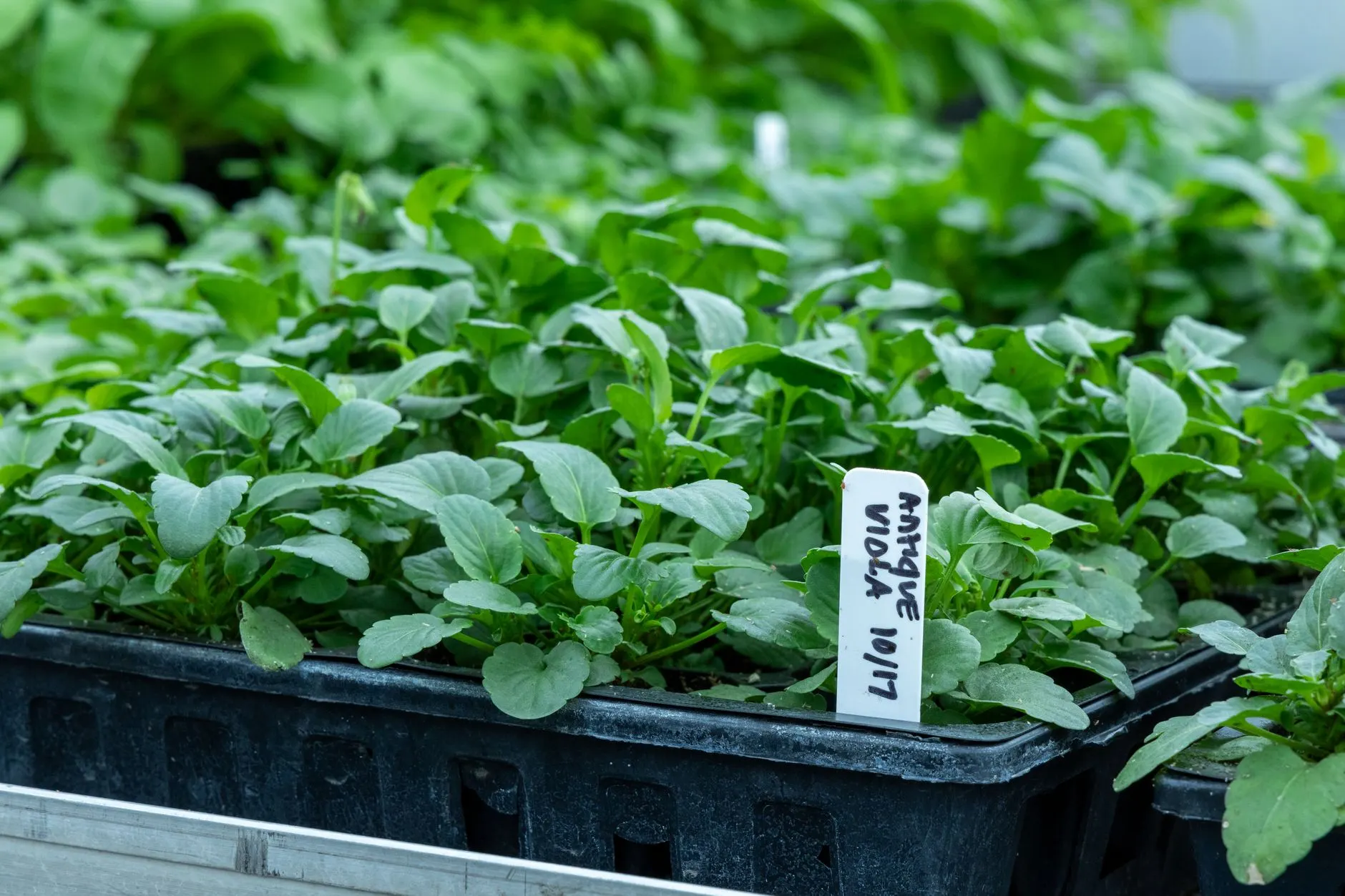
Every plant you bring home starts life in a thin plastic grow pot. It is the cheapest, lightest container that keeps roots alive while a plant travels from greenhouse to shelf to your kitchen counter. It is not a home. It is packaging that happens to hold soil.
There is no fixed expiry date for that packaging. A snake plant can sit in the same 6 inch grow pot for years, while basil in a 4 inch pot runs out of room within weeks. What sets the timeline is the root ball, plus two slower problems: the potting mix breaking down and fertilizer salts building up. Here is how to judge the window for the plants people buy most often, and what to do when you cannot repot yet.
What a nursery pot is actually for
Grow pots are built for a greenhouse, not a living room. They are sized by volume rather than by looks, most commonly as 4 inch pots and 1 gallon containers, and they are designed to do three things cheaply: hold a light soilless mix, drain fast, and let a grower water hundreds of plants a day. The mix inside is usually peat or coir with perlite, which is why it dries out so quickly and why it is not the same thing as garden soil.
That design works against you at home. A thin pot tips over, dries out fast in a sunny window, and offers no insulation for roots. The decorative pot you bought is a separate object, and it matters: Iowa State Extension walks through light, soil, container choice, and repotting as one connected routine rather than four unrelated chores. If the grow pot sits inside a cachepot with no drainage, empty the outer pot after every watering so the roots never stand in water.
How long you can realistically wait
Treat the middle column below as a rough guide, not a rule. Growth rate, light, and temperature change everything, and a plant in a dim corner uses water so slowly that it can stay put far longer than the same plant under a grow light.
| Plant group | Typical grow pot | Working window | What forces the move |
|---|---|---|---|
| Fast houseplants (pothos, philodendron, tradescantia) | 4 to 6 inch | One growing season or less | Roots fill the pot and watering jumps from weekly to every other day |
| Slow houseplants (snake plant, ZZ plant, haworthia) | 4 to 6 inch | A year or more | The mix breaking down, not the root space |
| Culinary herbs (basil, mint, parsley) | 4 inch | A few weeks | Rapid growth and heavy water use |
| Vegetable and flower starts | Cell pack or 4 inch | Two to six weeks | Roots circle the cell and growth stalls |
| Perennials from the nursery | 1 gallon | Up to one season | Circling roots that will not straighten out later |
| Succulents and cacti | 2 to 4 inch | Often a year or more | Overwatering risk, not crowding |
The pattern is simple. The faster a plant grows and the more water it drinks, the shorter its stay in a small pot. Basil and zucchini seedlings are sprinting; a snake plant is barely walking.
The one test that settles it
Forget counting months and check the roots. The signals that a plant is pot-bound show up before you ever touch the pot: the mix dries out unusually fast even in cool weather, roots appear at the drainage holes, and stems and leaves slow down or stop growing even with regular feeding in spring and summer. When you see those, slide the plant out and look at the bottom third of the root ball. If roots are circling the outside or so dense that you can barely see any mix, it is time.
Penn State Extension lists those signals and the root ball check as the deciding test, and adds a useful fork in the road: if you are happy with the plant’s current size, you do not have to upsize the pot at all. Trim the outer ring of roots, replant into the same container with fresh mix, and cut back some top growth. That keeps a large pothos or monstera at the size your shelf can actually hold.
If you would rather hand the job to a step-by-step process, our guide to repotting a houseplant covers pot selection, root teasing, and aftercare in order.
What happens when you leave it too long
Waiting is not harmless, it just moves the cost somewhere else.
- Circling roots get worse. Roots that wrap around the inside of a pot keep growing in circles after repotting, and they establish poorly when the plant finally goes into a garden bed. In a container, that same tight root mass chokes itself.
- The mix collapses. Peat and coir particles break down with every wet and dry cycle. Once the structure is gone, the mix holds water like a sponge, drainage slows, and the roots sit wet. That is the path to root rot in houseplants, which is far harder to fix than a repotting afternoon.
- Salts accumulate. Every fertilizer dose leaves mineral residue behind. A white crust on the pot rim or the soil surface is the visible version. Illinois Extension suggests leaching the pot every 4 to 6 months by pouring a large volume of plain water through the mix, letting it drain, and emptying the saucer.
- The mix turns water repellent. When peat dries out completely it can stop absorbing water, and irrigation runs straight down the gap between the root ball and the pot wall.
- Pests move in. Compacted, constantly damp mix plus stressed roots is exactly the habitat fungus gnats like. If you already have them, start with our fungus gnat control methods and then fix the potting situation.
If you cannot repot right now
Sometimes the plant has to wait for a weekend, a delivery, or a paycheck. These stopgaps work:
- Water more often and never let the pot sit in a saucer of standing water.
- Leach the pot with plain water to flush salt buildup, then empty the saucer.
- Ease off fertilizer. Houseplants generally need feeding only while they are actively growing, and most need it no more often than once every one to three months between March and September.
- Move a fast-drying plant out of harsh afternoon sun to buy time, since a cooler spot lowers water use.
- Slide the whole root ball, undisturbed, into one size larger pot with fresh mix around it. It is a temporary fix, but it works and takes minutes.
Root pruning, as described above, is the better option when you want to keep the plant small rather than move it up.
When you do repot, go up one size
Choose a container only slightly larger than the current one, roughly 1 to 2 inches wider in diameter. A container that is far too big leaves a large volume of wet mix with no roots to draw from it, and the plant sulks or rots instead of growing. Always use a pot with drainage holes, and if you want the look of a closed decorative pot, use it as a cachepot over the grow pot.
Best time to do it, and what to do with a brand new plant
Spring is the natural window, because that is when roots and shoots are already growing and can move into fresh mix quickly. Repotting in autumn or winter is not forbidden, but expect slow recovery: keep the plant warm and bright and water cautiously while the roots catch up.
For a plant you just carried home, give it one to two weeks to settle before you repot. Unless the pot is packed with circling roots, the mix is soaked, or pests came along for the ride, there is no rush. Check the leaves and the top of the soil for insects, keep it away from your other plants for a week or two, and let the plant tell you when the grow pot has done its job.


